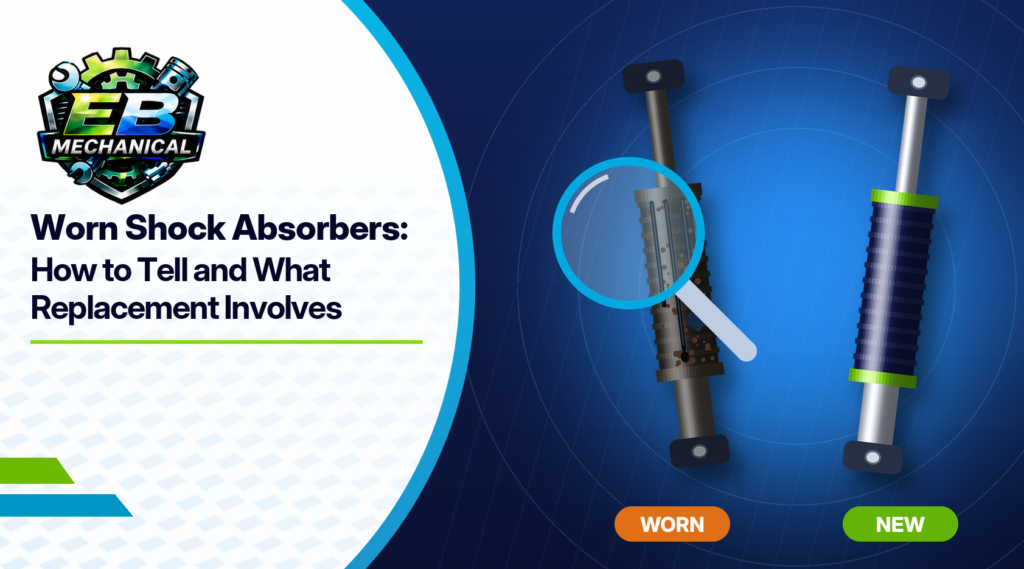
Worn Shock Absorbers: How to Tell and What Replacement Involves
Worn shock absorbers usually show up as a bouncy or floaty ride, nose-dive when braking, extra body roll in corners, uneven tyre wear or fluid on the shock body. Shocks are normally replaced rather than repaired, so shock absorber repair in practice means an inspection to confirm the cause, then replacement of the worn units and any related parts that need attention.
What Do Shock Absorbers Actually Do?
Many drivers assume shock absorbers hold the car up. They don’t. The springs carry the weight. The shock absorbers control how fast the springs compress and rebound, which keeps the tyres in firm contact with the road instead of letting the car keep bouncing after every bump.
Some vehicles use struts, which combine the shock absorber with part of the suspension structure. The principle is the same. When these parts wear, the car loses some of that control, and braking, cornering and ride comfort can all be affected.
Signs of Worn Shock Absorbers
Wear is usually gradual, which is why many drivers adapt without noticing. Depending on the vehicle, the signs may include:
- Bouncing that continues after bumps or dips
- A floaty or unsettled feeling at highway speed
- Nose-dive when braking, or the rear squatting when accelerating
- More body roll or sway in corners
- Cupped or uneven tyre wear
- Oily, wet fluid marks on the shock body
- Clunking or knocking over bumps
- A longer stopping distance than you’re used to
None of these proves the shocks are the problem. Springs, bushes, mounts, tyres and alignment can produce similar symptoms. That’s why a mechanic needs to inspect the components before recommending anything.
Simple Checks You Can Do Safely
Some quick observations can help you decide whether to book an inspection. They aren’t a diagnosis.
| Check | What to look for | Limits of the check |
|---|---|---|
| Bounce test | Park on level ground with the handbrake on. Press down firmly on one corner and release. The car should settle quickly rather than keep bouncing. | Doesn’t work equally well on every vehicle, and can pass even when shocks are worn |
| Visual look | Oily residue or wetness on the shock body, damaged rubber boots or mounts | Some films of dust and oil can look worse than they are, so a mechanic needs to judge |
| Tyre wear | Scalloped, patchy or uneven wear patterns | Can also come from alignment, pressure or other suspension wear |
| Road feel | Bouncing, nose-dive, sway or a vague feel at speed | Subjective, and hard to judge when the change is gradual |
Safety note: Stay out from under the car, and don’t jack it up or try to remove parts. Suspension components can store a lot of energy, and the work is best left to a workshop.
Why Worn Shocks Matter for Braking and Handling
Tyres can only grip when they’re in contact with the road. Worn shock absorbers may let the wheels bounce or skip over uneven surfaces, so the car may feel less stable, and braking distances can increase. Heavy loads, towing and rough roads can make this more noticeable.
How much the car is affected depends on the vehicle and how worn the shocks are. A mild change isn’t necessarily dangerous, but it shouldn’t be left indefinitely. If braking or handling feels noticeably different, have it checked promptly.
Shock Absorber Repair or Replacement: What’s Involved?
Shock absorbers can’t generally be repaired once they’re worn or leaking, so the job is usually replacement. The exact process varies by vehicle, but it may include:
- A conversation about the symptoms and a road test
- Raising the vehicle and inspecting the shocks or struts, mounts, bushes, boots, bump stops and related parts
- Removing the worn units and fitting replacements
- Replacing related parts if they’re worn, such as mounts or bushes
- Checking wheel alignment afterwards
- A final road test
Strut replacement can be a more involved job because it may require compressing the spring with specialised equipment. That’s another reason this isn’t a driveway job.
EB Mechanical’s suspension and steering repairs page lists shock absorber and strut replacement among its services, and notes that shocks and struts are replaced in pairs where needed, along with bushes, ball joints and tie rod ends.
Do Shocks Need Replacing in Pairs?
Often, yes. Replacing the shocks on the same axle together helps keep the handling balanced. If one side is new and the other is worn, the car can behave unevenly. Whether to replace front, rear or all four depends on the vehicle and what the inspection finds.
Why Wheel Alignment Often Follows
Replacing suspension or steering components can change the wheel alignment. That’s why a check afterwards is usually recommended, to protect your tyres and keep the car tracking straight. If you want to know more, EB Mechanical also offers tyres and wheel alignments.
How Long Do Shock Absorbers Last?
There’s no single figure. It depends on the vehicle, the roads, the loads and the quality of the parts. A ute that tows regularly or a 4WD used off-road may wear shocks differently from a car used mostly for short suburban trips.
The practical approach is to have them checked at servicing, and sooner if you notice changes. Your vehicle’s manufacturer may also give guidance in the handbook.
Utes, Vans and 4WDs: Extra Wear to Consider
Vehicles that carry heavy loads, tow or travel on unsealed roads put their shocks through more cycles and bigger movements than a lightly used sedan. A tradie ute loaded with tools every day may wear its rear shocks differently from a family SUV doing school runs.
That doesn’t mean they’ll fail sooner. It means how you use the vehicle matters. Mention towing, payload and rough-road driving when you book, so the inspection looks at the right things. Some vehicles may also have heavy-duty or load-rated options, and a mechanic can explain what suits yours.
What Affects the Repair?
The work depends on several things:
- The make, model and type of suspension
- Whether the vehicle has shocks or struts
- How worn the shocks are, and whether other parts are affected
- How the vehicle is used, including towing, loads and rough roads
- Whether alignment is needed afterwards
This is why a workshop can’t responsibly say what’s needed without an inspection. If additional work is found, it should be explained before it goes ahead.
Is It Safe to Keep Driving With Worn Shocks?
It depends on the severity. Mild wear isn’t usually an emergency, but don’t put it off for long. Arrange an inspection.
Stop in a safe place and seek help if:
- The steering suddenly feels loose or unresponsive
- The car pulls hard or feels unstable
- There’s a severe knocking noise
- You see significant fluid leaking
- Braking feels unsafe
Don’t continue driving if you believe the vehicle is unsafe.
Book a Suspension Inspection in Ormiston
EB Mechanical is an independent workshop at 5–7 Gordon Street, Ormiston QLD 4160. It works with drivers in Ormiston, Cleveland, Wellington Point, Capalaba, Thorneside, Alexandra Hills, Redland Bay and nearby Redlands and Bayside areas.
If you suspect worn shocks, contact EB Mechanical and describe what you’ve noticed. Share the make, model, year, kilometres and how the vehicle is used. The team can inspect it, explain what it finds, and discuss any additional work before going ahead. The exact repair depends on the inspection.
Frequently Asked Questions
How do I know if my shock absorbers are worn?
Signs may include a bouncy ride, nose-dive when braking, uneven tyre wear and fluid marks on the shock. These can have other causes, so an inspection is needed to confirm.
Can worn shock absorbers affect braking?
They can. Worn shocks may let the wheels bounce, which can reduce stability and increase stopping distance. The effect depends on the vehicle and the level of wear.
Can shock absorbers be repaired?
Generally, no. Worn or leaking shocks are usually replaced. A mechanic can also check related parts such as mounts and bushes.
Do I need to replace shock absorbers in pairs?
Often it’s recommended to replace them in pairs on the same axle for balanced handling, but it depends on the vehicle and the inspection.
Do I need a wheel alignment after replacing shocks?
It’s usually recommended, because replacing suspension parts can change the alignment.
Can I keep driving with worn shocks?
Mild wear isn’t always urgent, but don’t leave it. Stop and seek help if steering, braking or stability feels unsafe.
Need a car service in the Redlands?
EB Mechanical services and repairs all makes and models at our Ormiston workshop, close to Cleveland, Wellington Point and Capalaba. Clear advice and approved quotes before any work starts.