Engine Diagnostics: What a Scan Tells You When the Check Engine Light Comes On
A check engine light means the vehicle’s computer has detected a fault in the engine, emissions system or another connected component. An engine diagnostic scan can read stored fault codes and help identify the system that needs attention.
However, the code is not always a complete diagnosis. It may point to a sensor circuit, ignition problem, fuel-system issue or emissions fault without confirming which component has failed. A mechanic usually needs to combine the scan results with testing, a visual inspection and the vehicle’s symptoms.
Getting the problem checked early can help prevent a small issue from becoming a more expensive repair.
What Is an Engine Diagnostic Scan?
Modern vehicles use electronic control modules to monitor systems such as:
- Engine operation
- Fuel injection
- Ignition
- Emissions
- Turbocharging
- Transmission
- Exhaust sensors
- Cooling and temperature systems
When the vehicle detects a reading outside its expected range, it may store a diagnostic trouble code and activate a warning light.
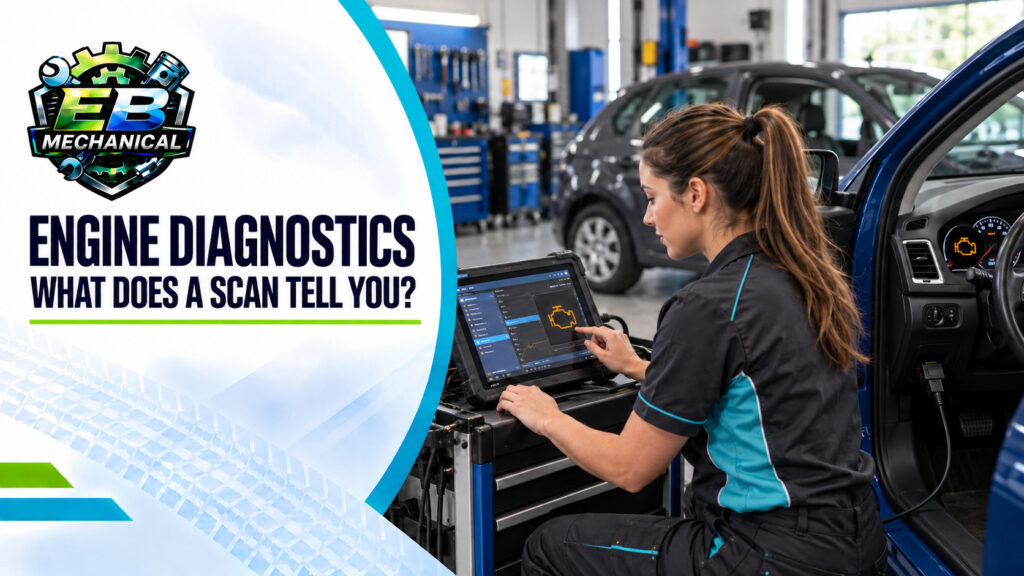
A scan tool connects to the vehicle’s diagnostic port and communicates with its onboard computer. Depending on the vehicle and equipment, the scan may identify stored, pending or manufacturer-specific codes. It may also show freeze-frame information and live data from sensors.
The scan gives the mechanic useful information about what the vehicle detected. It does not automatically identify the failed part or prove that replacing a particular component will fix the problem.
What Does the Check Engine Light Mean?
The check engine light, also called the malfunction indicator lamp, can appear for many different reasons. Some faults are minor, while others can affect engine performance, emissions or safe driving.
Common causes include:
- Loose or damaged fuel cap
- Engine misfire
- Faulty ignition coil
- Worn spark plug
- Oxygen sensor fault
- Airflow sensor problem
- Vacuum leak
- Fuel injector issue
- Catalytic converter problem
- Exhaust or emissions fault
- Turbocharger or boost-control problem
- Wiring or electrical connection fault
- Low battery voltage affecting vehicle modules
The warning light alone does not reveal the exact cause. A diagnostic scan and proper testing are needed to understand what is happening.
Is a Steady or Flashing Check Engine Light More Serious?
A steady check engine light still needs attention, even if the vehicle appears to drive normally. The fault may be affecting fuel economy, emissions or engine performance without creating an immediate drivability problem.
A flashing check engine light is generally more urgent. It may indicate an active misfire that can damage the catalytic converter or cause further engine problems.
| Warning light | What it may indicate | What to do |
|---|---|---|
| Steady light | A fault that may affect fuel economy, emissions or performance | Book a diagnostic check soon and avoid unnecessary driving |
| Flashing light | A possible active misfire that may damage the catalytic converter | Stop driving when safe and arrange professional assistance |
| Light with shaking, smoke or power loss | A fault that may be affecting safe operation | Pull over when safe and do not continue driving |
| Light that turned off | An intermittent fault that may still be stored in memory | Note when it appeared and arrange a scan |
If the light is flashing, the engine is shaking, power is reduced or the vehicle is producing smoke or a strong smell, stop driving when it is safe and arrange professional assistance.
Do not ignore other warning lights or symptoms simply because the check engine light is not flashing.
What Can an Engine Diagnostic Scan Tell You?
A scan may provide information about:
Stored Fault Codes
A stored code means the vehicle’s computer recorded a fault that met the conditions required to trigger it. The code may remain in memory even if the warning light later turns off.
Pending Fault Codes
A pending code may indicate that the computer noticed an abnormal reading but has not yet confirmed the fault through enough driving cycles. These codes can help identify intermittent problems.
Freeze-Frame Data
Some systems save information from the moment a fault was detected, such as:
- Engine speed
- Coolant temperature
- Vehicle speed
- Throttle position
- Fuel-trim readings
- Load conditions
This information can help the mechanic understand what the vehicle was doing when the fault occurred.
Live Sensor Data
A professional scan tool may display live readings from sensors while the engine is running or during a road test. Comparing the readings with expected values can help confirm whether a sensor, wiring connection or another component is causing the problem.
Faults in Other Modules
A basic code reader may only access engine-related codes. More advanced diagnostic equipment may also communicate with modules responsible for:
- Transmission
- ABS
- Airbags
- Stability control
- Body electronics
- Climate control
- Driver-assistance systems
The type of scan required depends on the vehicle and the warning light involved.
Why Is a Fault Code Not the Same as a Diagnosis?
A fault code usually identifies a system, circuit or condition—not necessarily a failed component.
For example, an oxygen-sensor-related code could be caused by:
- A faulty oxygen sensor
- Damaged wiring
- An exhaust leak
- An intake leak
- A fuel mixture problem
- A catalytic converter issue
Replacing the sensor without checking the rest of the system may not solve the problem.
The same applies to misfire codes. The underlying cause could be a spark plug, ignition coil, injector, compression problem, vacuum leak or wiring fault.
This is why clearing the light or replacing the part named in a code is not always the correct repair.
What Happens During Engine Diagnostics?
A thorough engine diagnostic check may involve several steps.
1. Discussing the Symptoms
The mechanic may ask:
- When did the light first appear?
- Was the engine cold or warm?
- Was the vehicle accelerating or idling?
- Did the vehicle lose power?
- Has fuel consumption changed?
- Are there unusual noises, smells or vibrations?
- Has any work recently been completed?
Your description can help the mechanic reproduce the fault.
2. Visual Inspection
The mechanic may inspect:
- Engine wiring
- Electrical connectors
- Hoses
- Intake components
- Vacuum lines
- Fuel and oil leaks
- Battery terminals
- Belts and visible engine components
A loose connector or damaged hose can sometimes create a warning light.
3. Connecting the Scan Tool
The scan tool is connected to the vehicle’s diagnostic port. The mechanic records the codes and checks whether they are current, stored or pending.
The codes should be documented before they are cleared.
4. Testing the Suspected System
Further testing may include:
- Checking sensor voltage
- Testing battery and charging voltage
- Measuring fuel pressure
- Inspecting ignition components
- Checking intake leaks
- Testing wiring continuity
- Comparing live data
- Conducting a compression or leak-down test
- Road-testing the vehicle
The exact process depends on the code and the vehicle’s symptoms.
5. Explaining the Repair Options
Once the cause has been investigated, the mechanic can explain:
- What has been found
- Whether the vehicle is safe to drive
- Which repair is required
- Whether other parts may be affected
- What should happen if the fault returns
- The expected repair time and cost
Can the Check Engine Light Turn Off by Itself?
Yes, the light may turn off if the vehicle no longer detects the fault over several driving cycles. However, the code may remain stored in the system.
A light that has switched off does not necessarily mean the problem has been permanently fixed. Intermittent wiring faults, loose connections or sensor problems can return later.
If the light appeared, it is worth recording when it happened and arranging a scan, particularly if the vehicle also experienced poor starting, rough running, reduced power or higher fuel consumption.
Should You Clear the Fault Code?
Clearing a code may turn the warning light off temporarily, but it does not repair the cause.
Clearing codes before diagnosis can also remove useful information, including freeze-frame data and confirmation that the vehicle has recently experienced a fault. It may also reset emissions monitors, which can make the vehicle appear “not ready” during some inspections.
The fault should be identified and repaired before the code is cleared.
Can Engine Diagnostics Find Every Mechanical Problem?
No. A scan tool is valuable, but it cannot detect every mechanical issue.
Some problems may not trigger a fault code, including:
- Worn engine mounts
- Mechanical oil leaks
- Low compression
- Worn timing components
- Suspension faults
- Brake problems
- Physical damage
- Some vacuum leaks
- Worn belts or pulleys
A mechanical inspection is often needed alongside the scan. This is particularly important when the vehicle has symptoms but no active code.
When Should You Book Engine Diagnostics?
Arrange a diagnostic check if:
- The check engine light stays on
- The light comes on and goes off repeatedly
- The engine is running roughly
- The vehicle is difficult to start
- The engine loses power
- Fuel consumption increases
- The car shakes or misfires
- There is a strong fuel or exhaust smell
- The vehicle enters limp mode
- Another warning light appears
- You hear a new engine noise
Do not wait for the vehicle to stop completely. Early testing may help identify a developing problem before it causes further damage.
What Should You Do Before Visiting a Mechanic?
Before booking an appointment, note:
- When the warning light appeared
- Whether it is steady or flashing
- What the vehicle was doing at the time
- Any recent repairs or servicing
- Changes in fuel economy
- Any unusual noises, smells or vibrations
- Whether the vehicle has lost power
Do not disconnect the battery or clear the code before the inspection unless a mechanic has advised you to do so.
Engine Diagnostics in Ormiston
A check engine light should not be treated as a diagnosis by itself. The scan provides information, but the cause must be confirmed through proper testing and inspection.
EB Mechanical provides engine diagnostics and mechanical repairs for drivers in Ormiston, Cleveland, Wellington Point, Capalaba, Thorneside, Redland Bay and surrounding Redlands areas.
If your check engine light has appeared, contact EB Mechanical to discuss the symptoms and arrange an inspection. You can also read EB Mechanical’s car maintenance tips for practical ways to identify warning signs early.
Frequently Asked Questions
What does an engine diagnostic scan check?
An engine diagnostic scan reads information stored by the vehicle’s onboard computer. It may identify stored or pending fault codes, show live sensor data and provide information about the system that needs further testing.
Does a diagnostic scan tell you which part to replace?
Not always. A code usually points to a system or condition rather than confirming a failed part. Further inspection and testing are needed before a repair is recommended.
Can I drive with the check engine light on?
If the light is steady and the vehicle is driving normally, arrange a diagnostic check soon and avoid unnecessary driving. If it is flashing or the vehicle is shaking, losing power or producing unusual smells, stop driving when safe and seek assistance.
Will clearing the code fix the problem?
No. Clearing a code only removes the stored warning information. If the underlying problem remains, the code and warning light may return.
Is a mechanical inspection still needed after a scan?
Often, yes. A scan may not detect mechanical problems that do not trigger a fault code. A complete diagnosis may require both electronic testing and a physical inspection.
How long does an engine diagnostic check take?
The time depends on the vehicle, fault and testing required. Reading a code may be quick, but confirming the cause can take longer if the problem is intermittent or involves wiring, fuel, ignition or mechanical components.
This article provides general automotive information only. A qualified mechanic should inspect your vehicle before any repair decision is made.
Need a car service in the Redlands?
EB Mechanical services and repairs all makes and models at our Ormiston workshop, close to Cleveland, Wellington Point and Capalaba. Clear advice and approved quotes before any work starts.